
Allen Parish Sex Offender Checks
The Louisiana State Sex Offender and Child Predator Registry, managed by Louisiana State Police BCII, is the authoritative state portal. The Allen Parish Sheriff’s Office registry page provides the local gateway, while APSO handles registration and verification for residents of Allen Parish. The national NSOPW search adds a cross-state layer.
Begin with the state portal for a parish, city, ZIP, address, or name search. Use APSO when the question concerns local registration appointments or suspected noncompliance. Searchers should gather the correct spelling, aliases, known location, and enough physical detail to distinguish similar profiles.
The official LSP registry gateway presents the state’s search route and safety terms.
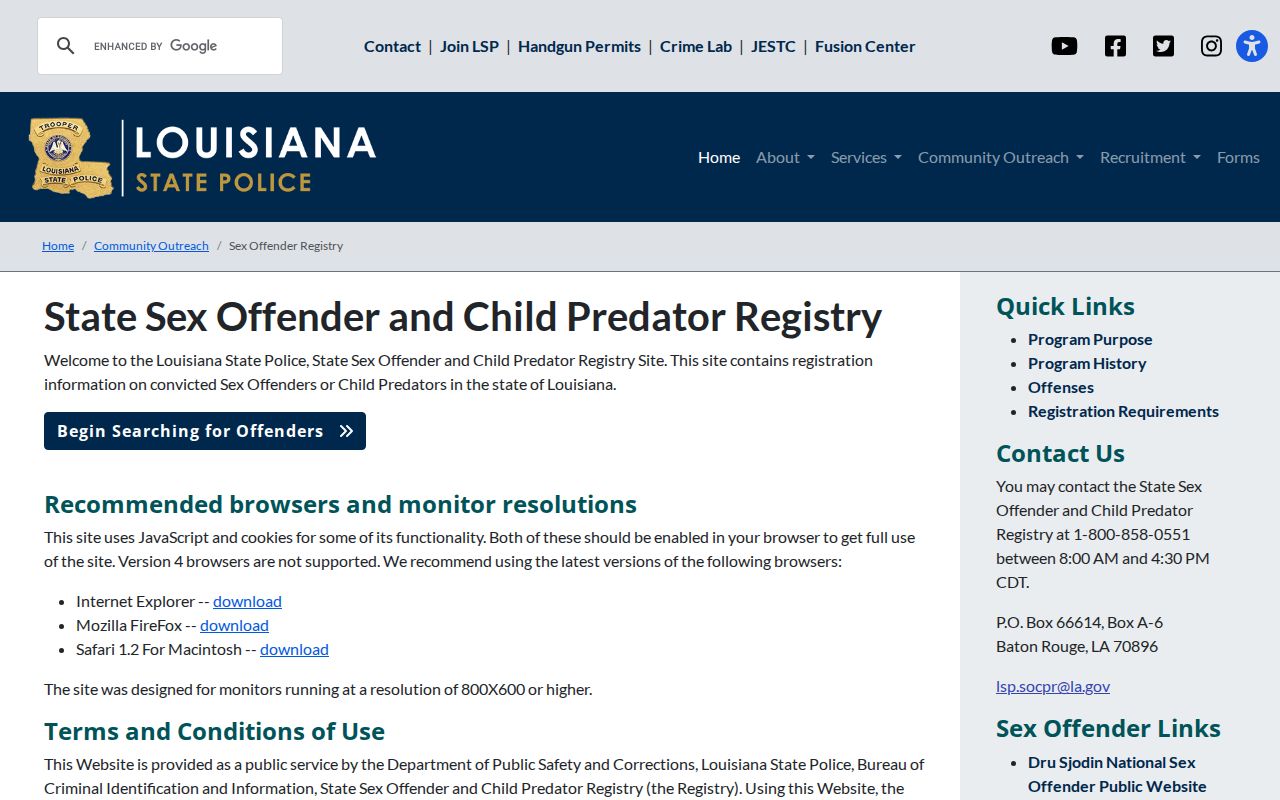
The interface is the right starting point, but each profile must still be checked for identity, status, and its last verification information.
Allen Parish Address and Radius Searches
A name search answers whether a known spelling returns a profile. An address search answers a different safety question: which public registrations appear around a location within the chosen radius. City, ZIP, and parish controls can narrow Allen Parish results. The map and list controls change how those matches are presented, while email alerts may provide proximity or change notices when enabled.
Radius choices can change and were not preserved as fixed values in the research. Read the live control rather than relying on an old screenshot. An address result may also shift after a registrant reports a move or after an agency processes an update. The public data is useful for awareness, not confrontation or a claim that every person near the location has been identified.
Louisiana Registry Searches
The state search accepts several routes, and none is mandatory for every query. Spelling and aliases matter in a name lookup. An address supplies the center point for proximity results. Allen Parish can be selected through the geography controls. Review the result list before opening a full profile, and compare several fields rather than relying on a photograph alone.
- Open the official Louisiana registry and read its conditions of use.
- Enter a first or last name, or choose an address, city, ZIP, parish, and available radius.
- Review map or list results and compare names, aliases, photographs, and locations.
- Open the likely profile and read the offense, registering agency, status, and verification details.
| Field Label | Type | Required | Notes |
|---|---|---|---|
| First or last name | Text | No | Spelling and aliases can affect results |
| Address | Text | Conditional | Starting point for proximity search |
| City, ZIP, or parish | Text/dropdown | No | Select Allen Parish for parish results |
| Radius | Dropdown | Conditional | Read current options on the live portal |
| Map or list | View control | No | Changes result presentation |
| Email alerts | Registration | No | Proximity or change notices where enabled |
Registering With APSO in Allen Parish
A person residing in Allen Parish who has a registration duty reports to APSO at 7340 LA-26 West in Oberlin. Call 337-639-4353 for an appointment and to confirm documents and any fee. The sheriff does not publish a registration-desk schedule, so an unplanned visit may not reach the right staff.
Local agencies collect required registration data, including fingerprints, and send the information to BCII. Under R.S. 15:542.1.5, that transmission generally occurs within three business days. Address changes and other changes trigger separate reporting duties. A public profile may lag a very recent local update, which is one reason LSP warns that day-to-day accuracy cannot be guaranteed.
The APSO local registry gateway shows the parish entry point.
The gateway supports public access, while appointment, document, and fee questions still require a call to the sheriff.
Allen Parish Registry Profiles Explained
A registry profile combines identity, location, offense, and compliance fields. Not every Allen Parish profile contains every possible item. A photograph and physical traits help narrow a match, but age, scars, tattoos, vehicles, aliases, and registering agency may be just as important. Offense information should be read with the conviction jurisdiction and statute. Registration dates and last verification help place the public display in time.
| Name & Aliases | Legal name and known alternate names used to locate and compare a profile. |
|---|---|
| Photo & Physical Description | Photograph, sex, race, age or DOB, height, weight, hair, eyes, scars, marks, and tattoos when shown. |
| Registered Address | Public residential location and related employer or school information where law permits display. |
| Offense & Statute | Conviction jurisdiction, offense description, statute, conviction date, and authorized victim category fields. |
| Period / Duty | Offense-based registration term rather than a local risk score. |
| Registration Status | Compliance status, registering agency, registration dates, and last verification when supplied. |
Vehicle information and visible marks can help resolve two similar names. They should not be used to follow, contact, or confront a registrant.
Allen Parish Matches Need Care
A registry match does not prove identity by itself. LSP states that much of the displayed data comes from registrants and other reporting entities, and only fingerprints provide positive identification. Compare the full set of public fields. If the identity or status has legal importance, use the proper official process rather than treating a name or photograph as conclusive.
The reverse is also true. No search result does not prove that no duty exists. A miss may follow a spelling choice, alias, location change, delayed update, another jurisdiction, or search setting. For personal and family safety, combine the registry with direct awareness and report a specific concern to law enforcement.
Note: Registry data is a current public-safety view, not a complete account of every arrest, court filing, or criminal-history event.
Registration Levels and Duties in Louisiana
Louisiana does not assign Allen Parish registrants a local public risk score. LSP’s registration requirements organize duties under state statutes and offense categories. R.S. 15:544 commonly sets periods of fifteen years for many covered offenses, twenty-five years for specified aggravated or repeat categories, and life for aggravated offenses, sexual predators, and other listed cases. Release dates and interruption rules can affect how a term is measured.
In-person renewal frequency is set by R.S. 15:542.1.1 and varies by category. It should be verified against the governing statute and the person’s profile. Converting Louisiana’s system into generic Tier I, Tier II, and Tier III labels would misstate the research.
| Offense-Based Period | Common Duration | Verification |
|---|---|---|
| Many covered offenses | 15 years | Frequency varies by statutory category |
| Specified aggravated or repeat categories | 25 years | Frequency varies by statutory category |
| Aggravated, sexual predator, and other enumerated cases | Life | Frequency varies by statutory category |
The LSP requirements page includes the statute table used to check those duties.
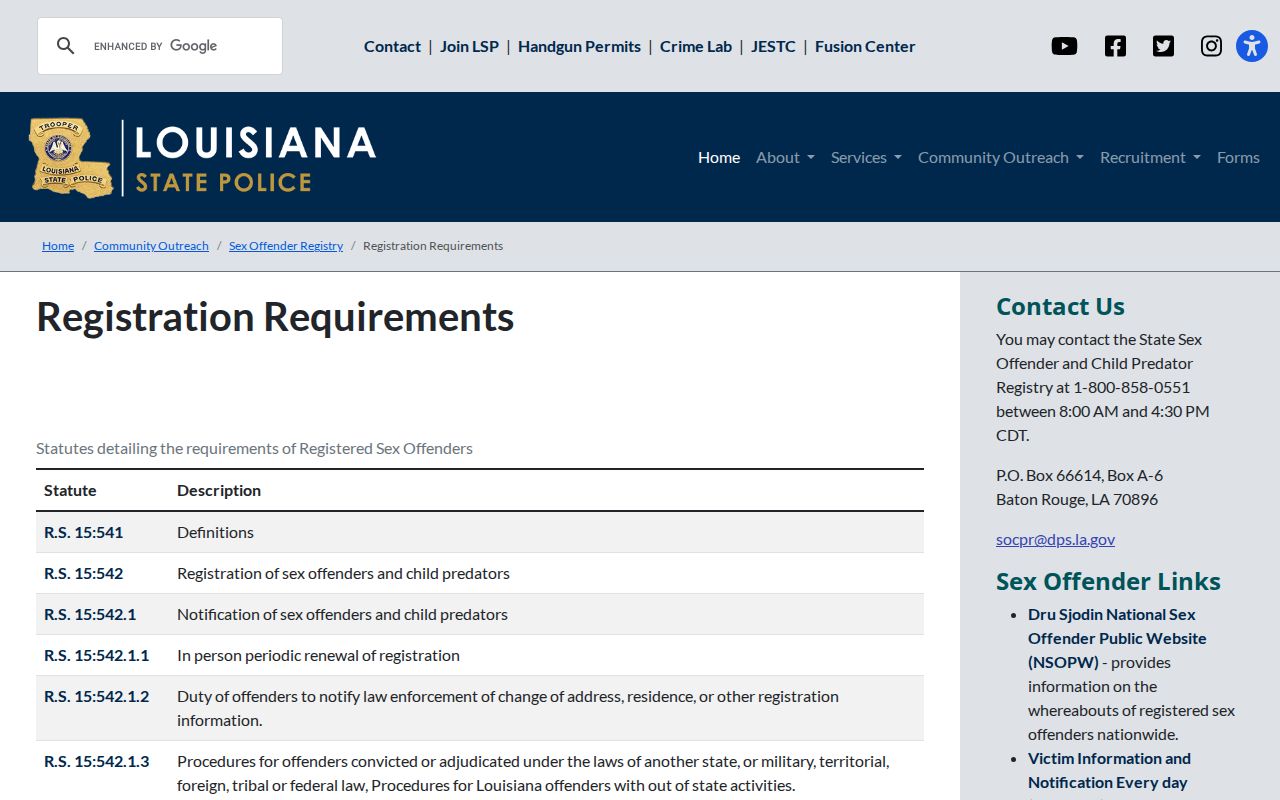
The table is a legal starting point. The exact offense, release history, status, and current law control an individual duty.
Allen Parish and National Registry Results
Dru Sjodin National Sex Offender Public Website, or NSOPW, searches participating jurisdictions across state lines. It is useful when a known address sits near another state, a person recently moved, or the correct registration jurisdiction is uncertain. For a person tied only to Allen Parish, the LSP portal remains the authoritative Louisiana source.
The national interface provides a separate cross-state search route.
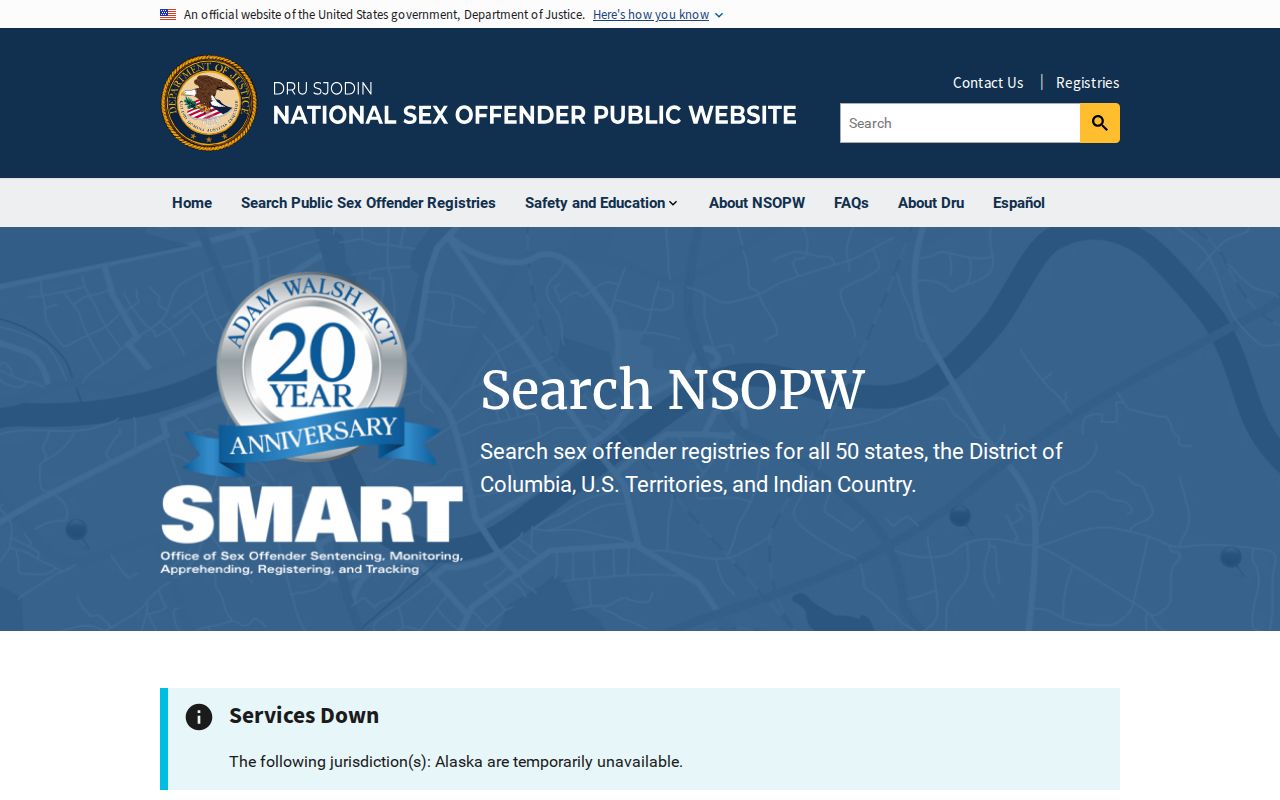
A difference between NSOPW and the Louisiana display calls for closer review of jurisdiction, update timing, aliases, and search inputs, not a quick conclusion.
Reporting Allen Parish Registry Concerns
Suspected noncompliance should be reported to APSO or LSP. Give the agency a clear basis for the concern, such as a profile, observed public fact, or address issue. Do not investigate through contact with the registrant or household. Law enforcement can compare nonpublic registration records, fingerprints, reporting dates, and statutory duties.
Louisiana also imposes residence and presence restrictions on some covered offenders. Applicability depends on the offense and status and should be checked against R.S. 14:91.1 and related current provisions. A map pin alone does not establish a violation. Boundaries, protected places, exceptions, and the person’s governing law all matter.
Using Allen Parish Registry Data Lawfully
The Allen Parish sex offender registry supports community awareness and safety planning. It may help residents understand public registrations around a home, school route, or other location. LSP cautions that information may change and cannot be guaranteed accurate each day. Verify details through the official registry and report a suspected problem through APSO or LSP.
Registry information is not permission for vigilantism. Do not publish unsupported claims, threaten a person, approach a household, or interfere with lawful activity. The correct response to a possible violation is an agency report. The related Allen Parish Court Case Lookup may show a public prosecution record, but a court file and registry duty answer different questions.
Use Registry Data Lawfully: Do not use registry information to harass, threaten, intimidate, or commit a crime against a registrant or household. Use the official law-enforcement channel for safety concerns.