
Oberlin Criminal History Checks
Identify the creator before traveling. The Oberlin Police Department keeps its incident and arrest records. The parish clerk maintains filed 33rd JDC cases, while APSO maintains sheriff reports and detention records. A local court handles assigned municipal matters.
- Contact OPD through the municipal channel for the city incident narrative, citation, arrest report, or media.
- Identify the incident number, date, time, location, involved person, and exact component requested.
- Ask the local court clerk about an ordinance, traffic, or assigned city matter and any local bench warrant.
- Use Arrest Search for APSO bookings and Court Case Lookup for 33rd JDC filings.
- Use Louisiana State Police BCII Right to Review for personal statewide repository history.
Three Oberlin Stops for One Event
One OPD incident can create three distinct records. The municipal building holds the city police file. The Allen Parish Detention Center at 7340 LA-26 West holds a booking if the person was detained. The courthouse at 400 West Sixth Avenue holds a felony or district prosecution after filing. Proximity does not merge custody.
The district attorney at 105 South Fifth Street screens and prosecutes parish cases, but its working file is not the clerk’s public docket. Request each record from the office that created it. A wrong-office referral should lead to rerouting, not a conclusion that no record exists.
Records at the Oberlin Police Department
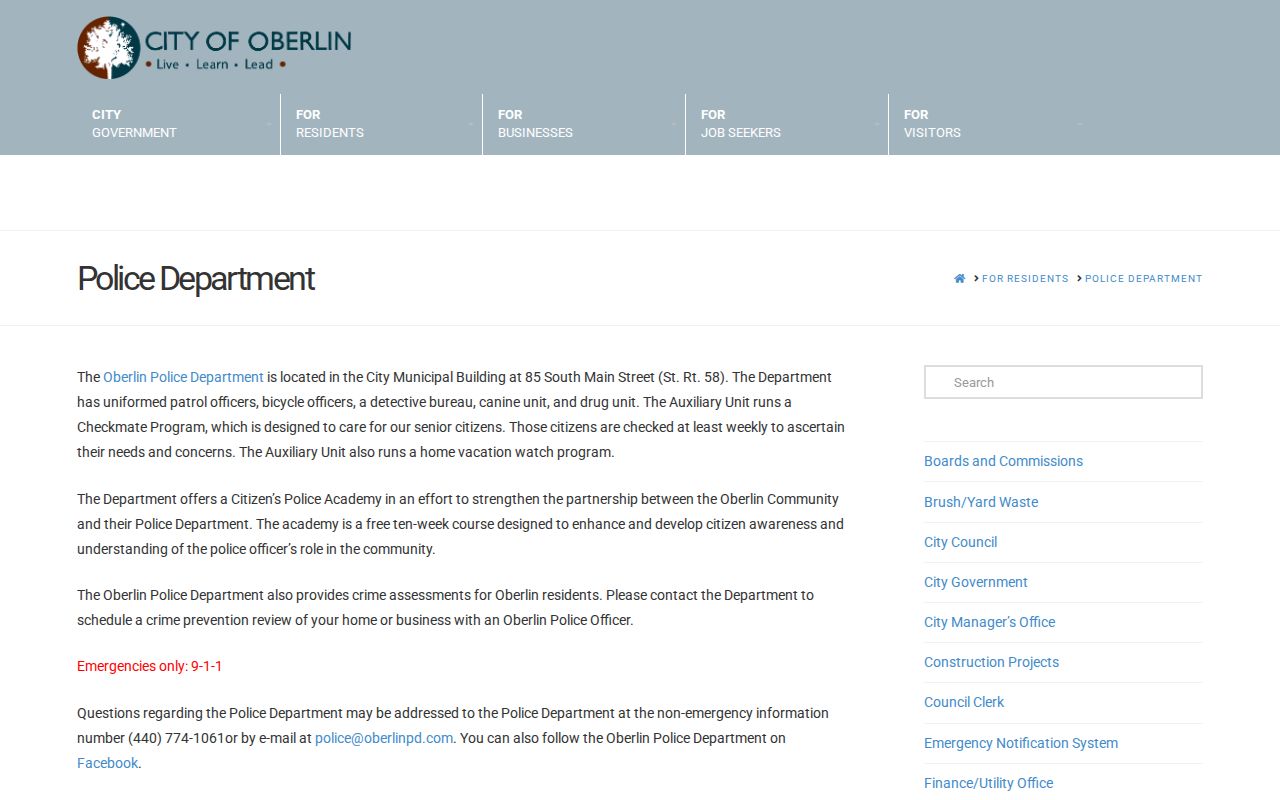
The official city police page identifies the municipal-building channel. Research found no dedicated downloadable report form, anonymous case portal, complete blotter, published city app, records fee, or guaranteed turnaround. Use the city website to verify current contact information before a visit.
Ask for a defined record rather than a compiled history. Include the incident number, date and approximate time, place, involved person, and report or recording type. Seek electronic delivery and an estimate. If protected material can be separated, request the redacted public remainder.
The official Oberlin Police Department page identifies the municipal police channel.
Plan an Oberlin Records Day
The Allen Parish Clerk’s published hours are 8:00 a.m. to 4:30 p.m. weekdays except legal holidays. The District 33 public defender closes at 3:00 p.m. and is not a public-records service. The district attorney publishes 8:00 a.m. to noon and 1:00 to 4:00 p.m., with a lunch closure. APSO is outside the courthouse complex.
Begin with the clerk when a certified case outcome is the priority. Call other offices before travel because parking, security, device rules, local-court schedules, and copy fees were not published. The courthouse’s concentration of services is convenient only after the correct custodian is identified.
Booking and Arrest Records in Oberlin
OPD keeps the arrest narrative it creates; APSO keeps a parish booking if the person enters the detention center. The free sheriff roster separates current and released views. Contact APSO at 337-639-4353 for a booking or sheriff report that is not answered by the public roster.
Do not treat the roster as a complete city arrest log. A citation may produce no intake, and an arresting agency may be APSO, OPD, Louisiana State Police, tribal law enforcement, or another authority. Use the agency name and record number to route the request.
The APSO public-service page supplies the sheriff and jail information channel.
Five Dates Can Describe One Case
An Oberlin event can have an incident date, arrest date, booking date, court filing date, and disposition date. They are not synonyms. The sheriff roster may organize by booking, while the clerk may search by filing year. Louisiana BCII uses the fingerprint booking cycle and may require an arrest date matching within one day when a disposition is added.
Record all available dates and identifiers. If a docket search by filing date fails, try the arrest year and case number. If repository data lacks the outcome, obtain a certified disposition that ties the court result to the correct arrest cycle.
The Oberlin Municipal Court File
Oberlin’s municipal or mayor's court channel maintains local ordinance, traffic, and other assigned matters, including local bench-warrant events. No verified anonymous case portal was found. Contact the clerk and distinguish local jurisdiction from a 33rd JDC felony or district case.
| Court Name | Oberlin municipal or mayor's court channel |
|---|---|
| Case Types Heard | Local ordinance, traffic, citations, and assigned municipal matters |
| Case Lookup Channel | Contact the local clerk; no anonymous portal was verified |
| What the Docket Shows | Ticket or docket number, charge, dates, minutes, status, disposition, and public warrant activity |
| Copies & Fees | Confirm inspection, plain copies, certified copies, and fees directly |
How Oberlin Records Reach the County
OPD retains its report. APSO retains its booking. The local court retains assigned municipal matters, and the Allen Parish Clerk retains filed 33rd JDC cases. Fingerprint-supported events and qualifying dispositions may reach Louisiana State Police BCII.
Record flow: Oberlin Police Department › Oberlin local court or Allen Parish Courts › Louisiana State Police BCII
Use city and sheriff sources for recent activity, the correct clerk for a filed outcome, and BCII Right to Review for personal statewide repository review. The source sequence matters more than physical office distance.
The official City of Oberlin website gives the municipal government context.
Local Warrant or District Bench Warrant
First identify the issuing court. A local bench warrant belongs with the municipal or mayor's court and OPD channel. A district bench warrant belongs with the Allen Parish Clerk and 33rd JDC. APSO’s Most Wanted selections are not a complete public warrant database.
For sheriff warrants call APSO at 337-639-4353. A payment receipt alone may not prove recall, so ask the issuing court for the docket event or certified recall. Louisiana’s law-enforcement warrant network is not an open public search service.
Walking a Disposition to BCII
At the courthouse, request the docket sheet and final minute entry before ordering a large file. A public index may show docket, division, dates, charges, and status, while juvenile, victim, grand-jury, sealed, and protected identifying material may be redacted.
For repository correction, obtain a certified record containing name and date of birth, arrest or booking date, original and amended charges, outcome, and sentence. Submit it through the BCII correction process. The courthouse disposition, not an arrest profile, establishes the final case result.
The APSO OCV App
APSO promotes an OCV mobile app with contact, tips, news, payments, jail information, emergency resources, inmate roster, sex offenders, most wanted, forms, alerts, and victim notifications. Most functions also appear on the responsive sheriff website; no app-only Oberlin records request was verified.
Use the app as a gateway and notification tool, not as proof of a complete history. Confirm bookings with APSO, court outcomes with the clerk, and registry details through the Sex Offender Lookup official routes.
Do Not Combine Oberlin Record Counts
Use an official agency-year table for Oberlin Police Department crime data and retain year and coverage notes. Do not merge OPD incidents, parish-wide APSO reports, jail bookings, and court filings. Each counts a different stage or geographic scope.
No current official OPD annual report or complete official local crime table was located. Missing reporting is not zero crime. Oberlin’s 2020 Census baseline was about 1,402, but population vintages must be labeled rather than presented as a current live count.
What to Do at the Wrong Counter
Describe the event and ask which office created the requested item. An OPD clerk may direct a booking question to APSO; the sheriff may direct a disposition request to the parish clerk. A referral is evidence of divided custody, not proof the underlying event is absent. Note the agency, incident or docket number, and date before moving to the next office.
Do not ask the public defender for general public records merely because its office is at the courthouse. The defender represents appointed clients. Likewise, the district attorney’s prosecution role does not turn its working file into the clerk’s public case file. The creator-and-stage test keeps an Oberlin search focused.
Verify the Person and the Outcome
Compare more than a name. Use a docket or incident number, arresting agency, relevant dates, and date of birth where lawfully accepted. An arrest entry is an allegation, a booking is a custody snapshot, and an index status may precede the final minute entry. Similar names can create false matches.
Keep the source office and retrieval date with every copy. When sources conflict, use OPD for its incident, APSO for its booking, and the issuing court for its final disposition. A certified outcome is the sound basis for correcting a personal BCII record.
The Allen Parish Courthouse houses the clerk and 33rd JDC at 400 West Sixth Avenue, but it is not the sheriff’s detention counter. APSO headquarters and the detention center are at 7340 LA-26 West. The district attorney is at 105 South Fifth Street. A researcher who records these locations before traveling avoids treating all Oberlin justice offices as one repository and can direct copy, booking, prosecution, and police questions correctly.
Office hours shape a same-day records plan. The clerk publishes weekday hours from 8:00 a.m. to 4:30 p.m., except legal holidays. The district attorney closes from noon to 1:00 p.m. and ends its public day at 4:00 p.m. The public defender closes at 3:00 p.m. and serves appointed clients rather than acting as a public records counter. Call APSO before driving to its LA-26 location because specific copy procedures and building access details were not published.
If a case outcome must be matched to Louisiana BCII, ask the clerk for a certified disposition that includes the identifying information, arrest or booking date, original charge, amended charge, outcome, and sentence. BCII’s arrest date may need to match within one day of the fingerprint booking event. Searching only by the court filing date can therefore miss the repository cycle even when the correct Oberlin case has been found.
When ordering copies, specify inspection, plain copies, or certification and ask for the current charge before production. Published research did not establish the courthouse’s certified-copy fee, parking rules, device policy, or security procedure. Confirming these details by phone prevents an avoidable return trip.
Oberlin Record Access Rules
Louisiana Public Records Law provides access to existing records, subject to exceptions for active investigations, juveniles, victims, grand-jury material, sealed cases, medical information, and protected identifiers. A custodian does not have to compile a statewide history. Describe the existing document and ask for segregable redacted portions.
Key Statutes:
Louisiana Public Records Law, R.S. 44:1 - defines public records and general access.
Louisiana R.S. 44:3 - governs protected law-enforcement material.
Louisiana R.S. 15:587 - governs official criminal-history dissemination.